

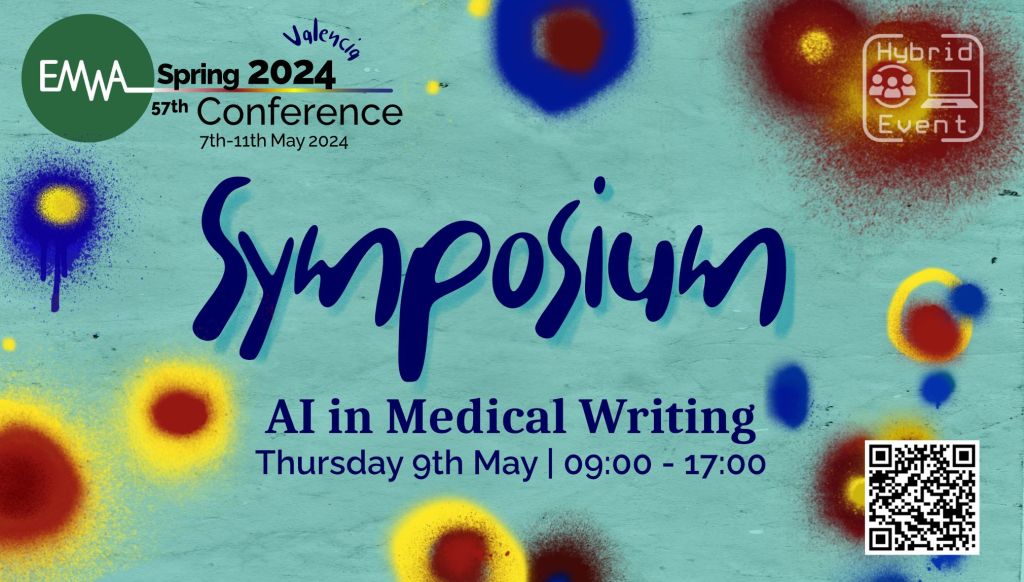

The 12th European Medical Writers Association (EMWA) symposium, entitled ‘AI in Medical Writing’ took place on 9 May. The symposium explored technological aspects of AI, ethical considerations, and showcased practical applications for medical writers and communications specialists. If you missed the afternoon session, you can catch up on the key themes with our summaries below, or get a quick refresher if you were in attendance!
You can read our summary of the morning session of the symposium here.
Librarians are essential in bridging the AI gaps
KEY TAKEAWAY
- AI presents medical writers and the broader pharmaceutical industry with great opportunities but also valid concerns; library teams have an important role to play in supporting effective and ethical use of AI and promoting AI literacy.
In this session, Jill Shuman (Takeda) considered the proliferation of artificial intelligence (AI) tools and the opportunities and challenges they pose for medical writers. It is estimated that generative AI can bring $60–100 billion value to the pharmaceutical industry annually. AI is also a powerful tool in the face of ‘infobesity’ – with 2 new papers added on PubMed every minute, keeping up with the literature becomes ever more challenging.
There is a pressing need for tools that can assess and extract scientific information faster and deeper, with AI being particularly useful for applications including data extraction for systematic reviews and competitive intelligence. At the same time, AI raises a number of valid concerns, particularly with regards to ethical and copyright issues. Library teams within pharmaceutical organisations have already been looking at the issues for some time and have a critical role to play in supporting the appropriate adoption of AI. In particular, librarians can work to promote AI literacy, ensuring that use of AI tools is both effective and ethical. They can also support medical writers in developing the AI skills that will soon be a prerequisite for the job.
Library teams within pharmaceutical organisations have a critical role to play in supporting the appropriate adoption of AI.


AI-assisted tool for academic writing – supporting researchers in sharing knowledge
KEY TAKEAWAY
- Application of AI to the process of creating a book can reduce the time to publication and the burden on authors and editors, but humans remain central to the process.
Vivien Bender (Springer Nature) described an innovative project that brought together authors, editors, and experts from across Springer Nature to develop a new academic book using generative AI. Creation of the book followed a design process approach, with the team drawing on AI support at each stage in the process. The process also followed 5 principles for the use of AI in publishing: dignity, respect, and minimising harm; fairness and equity; transparency; accountability; and privacy and data governance.
The experiment highlighted the importance of engaging an interdisciplinary team in the development process and that, while AI can be a valuable and powerful tool, humans remain central to the process, relying on their expertise on the subject matter and skills in areas such as high-quality editing. Humans must also continue to take ultimate responsibility for the content. The application of AI accelerated the publication process, making topical information available sooner and reducing the time demands on authors. By assisting authors in areas where they have less experience or skills, AI can also lower barriers for those looking to publish their work.
The experiment highlighted the importance of engaging an interdisciplinary team when incorporating AI into the writing process.


Translation in the era of AI
KEY TAKEAWAY
- AI is a game-changer for translation services; human translators still have an important role to play but need to adapt and refine their skills to make effective use of AI in their role.
AI is having a dramatic impact on translation services, raising the question of whether human translation has a future in the face of rapidly advancing AI tools. Translator and conference interpreter Nora Díaz (Consultant Translator) described the arrival of AI as a game-changer, noting that, depending on the AI engine, machine translation can now rival human translation. Generative AI is widely available and can provide context-aware translations adapted to particular audiences. The potential benefits of AI translation include faster turnaround combined with improved accuracy.
The uptake of AI by translation companies has been rapid, driven by the need to remain competitive. The impact for translators has been mixed – while AI provides them with enhanced tools it also puts their job security at risk. However, companies are increasingly adopting a hybrid approach which retains the human translator as an essential element, with AI used to generate a ‘pre-translation’ which the human translator then refines through a very close edit and check. In this rapidly changing environment, translators need to reskill and upskill. In particular, translators should look to further their skills in developing AI prompts, which are critical to ensuring the quality of machine translations.
Translators should look to further their skills in developing AI prompts, which are critical to ensuring the quality of machine translations.

Structured content authoring
KEY TAKEAWAY
- Generative AI is well suited to use alongside structured content authoring in the development of a range of clinical documents.
Mati Kargren (Parexel International) considered the application of AI and structured content authoring (SCA) to the development of clinical documents across the product lifecycle. SCA uses an approach in which information is broken down into components (eg, study design, patient characteristics, interventions, etc.) that can then be rearranged and reused across multiple documents. Benefits of the SCA approach can include increased consistency, faster turnaround times, reduced need for manual intervention, and improved tracking of content.
AI can be particularly effective where clear structures are in place. Structured content makes for more reliable AI training and, in turn, more reliable AI performance. At the same time, the clear and consistent structure of many clinical documents makes them well suited for generation by AI trained on the structured content.
AI can be particularly effective where clear structures are in place. Structured content makes for more reliable AI training and, in turn, more reliable AI performance.


Dispelling the myths of ChatGPT and misconceptions of AI for your medical writing
KEY TAKEAWAY
- Generative AI and machine learning are not about to replace human medical writers, but medical writers need to adapt and learn how to use AI appropriately in their work.
Depending on where you look, AI is either our gateway to a golden age or a fast-track to unemployment and poverty. David Piester (Symbiance) looked to dispel some of the myths surrounding generative AI and its impact on medical writers. While concerns about the risks of AI are valid, fear is beginning to subside with growing familiarity. The reality of AI and machine learning is that, while it will have an important role to play, it will not replace medical writers or be able to write a complete clinical study report (CSR) on its own.
Medical writers need to work alongside AI, using it for specific tasks, such as structured and formatted processes, and for repetitive and data-heavy tasks. The requirement for closed-loop systems to ensure data privacy and intellectual property rights is a key barrier to the use of AI to generate CSRs and other documentation. The medical writer remains essential and in short supply. However, writers need to adapt to apply AI effectively and appropriately. As Piester noted: “AI will not replace you. A person who’s using AI will replace you.”
While concerns about the risks of AI are valid, fear is beginning to subside as familiarity with AI grows.


Empowering regulatory medical writers: leveraging tools to enhance your writing
KEY TAKEAWAY
- Generative AI tools are available that offer seamless integration with other applications, and are best deployed in a small batch approach to specific tasks within the overall document development process.
Philip Burridge (Morula Health) considered the AI tools available to medical writers to assist and enhance their work. In particular, Burridge focused on Microsoft Copilot, based on its seamless integration with widely used Microsoft Office applications such as Word, PowerPoint, and Excel. Given the critical issue of data confidentiality, it was noted that prompts, responses, and data used within Copilot remain within the Microsoft 365 service boundary and can be locked down by particular users and accounts. However, this does not preclude Microsoft using your data in some way.
Benefits to medical writers of AI tools such as Microsoft Copilot include time savings related to mundane and repetitive tasks, accurate outputs, integration with other applications such as word processing and spreadsheet programmes, and data security on a user level. It was noted that quality outputs require quality inputs in the form of well-devised prompts, and that the best use of AI is for small batch work, applied to specific, structured tasks within the overall document development process.
Quality AI outputs require quality inputs in the form of well-devised prompts.


How will medical writers work with AI
KEY TAKEAWAY
- Use of AI tools has the potential to allow medical writers to focus on the strategic elements of their role; while writers need to know how to use the tools, they do not need to understand in detail how they work.
It is clear that AI is driving a shift in the role of the medical writer. Julia Forjanic Klapproth (Trilogy Writing and Consulting) explored how medical writers can work together with AI and examined some common misconceptions concerning AI and medical writing. Firstly, Forjanic Klapproth countered the opinion that medical writers will need to be highly tech-savvy, noting that they will not need to understand in detail how AI tools work in order to use them. She used the analogy that most of us can drive a car successfully but relatively few understand the detailed workings of car motors. Learning to use AI tools should be no different from mastering other software tools.
Another misconception is that AI will remove the strategic element of the writer role. Conversely, Forjanic Klapproth argued that AI will make medical writers more strategic, freeing them from mundane and repetitive tasks to focus on guiding the direction of projects and gaining deeper insights from the data. The medical writer has a key role as the ‘architect’ and ‘story builder’ of the output, using their vision to steer the AI tool to a successful output. Use of AI should also reduce the potential for bias compared with humans when extracting and assessing data. Ultimately, AI should allow medical writers to get more done more quickly and with greater consistency and accuracy, at the same time as allowing them to focus on strategic tasks such as meaning and messaging.
AI should allow medical writers to get more done more quickly and with greater consistency and accuracy.


AI in regulatory medical writing – opportunities and challenges
KEY TAKEAWAY
- Use of rules-based AI can substantially improve speed and efficiency of preparing regulatory documents, freeing medical writers from repetitive tasks to focus on strategic authoring.
Eishita Agarwal (GSK) looked at how innovative AI-driven systems are driving advances in regulatory medical writing. In particular, rules-based AI can be used to increase the speed and efficiency of developing documents such as study reports and clinical summaries. AI tools can also improve accuracy and consistency. Agarwal emphasised that AI is an enabling technology rather than a ‘magic bullet’ and needs to be deployed alongside other enablers within a multidisciplinary approach engaging all key stakeholders.
Practical experience of deploying rules-based AI to development of 10 CSRs demonstrated substantial reductions (~50%) in development time for 70% of the CSRs. For the remaining 30%, efficiencies were held back somewhat by resistance to changing mindsets and adopting new working practices. Use of AI is redefining the medical writer role, empowering writers to focus on strategic authoring while deploying technology to handle repetitive tasks.
Short intro to the EU AI Act and its impact
KEY TAKEAWAY
- The European Union AI Act is a long overdue piece of legislation that aims to maximise the benefits of AI while mitigating the risks, and holds providers and deployers accountable for the ethical and risk-conscious implementation of AI.
The European Union (EU) AI Act is a ground-breaking piece of regulation that governs development and use of AI within the EU; it aims to promote human-centric and trustworthy AI at the same time as protecting health, safety, and fundamental rights, while still supporting innovation. The legislative framework around AI is a dynamic and rapidly evolving field, and Ward Neefs (Pfizer) overviewed key features of the AI Act.
The Act classifies the risks associated with AI into 4 categories – minimal, limited, high, and unacceptable – with healthcare falling within the high-risk category and thus requiring the strictest safeguards. It overlays existing regulations in areas such as medical devices and in vitro diagnostics, bringing with it some additional requirements. Neefs concluded that AI carries a high risk if it is applied without careful consideration of its limitations and potential for bias. However, if good data modelling practices are followed, machine learning has the potential to do more good than harm.
The EU AI Act aims to promote human-centric and trustworthy AI at the same time as protecting health, safety, and fundamental rights, while still supporting innovation.

How to create an effective prompt: a mandatory skill for the medical writers
KEY TAKEAWAY
- Prompt engineering is becoming a mandatory skill for medical writers to learn how to make effective use of generative AI tools.
Namrata Singh (Turacoz Group) addressed the critical issue of creating prompts for AI tools and how this is becoming an essential skill for medical writers. Prompts are instructions entered into the AI interface and need to be engineered to yield precise, coherent, and pertinent responses. Prompts fall into a number of different categories but all require a considered and creative approach in order to achieve the best outputs.
Singh described the CLEAR Framework, which encapsulates 5 factors that are central to effective prompt engineering: Concise, Logical, Explicit, Adaptive, and Reflective. An understanding of the parameters that determine the effectiveness of prompts is helpful, but learning prompt engineering comes from exploring, interacting with the tools, and learning from mistakes.
Learning prompt engineering comes from exploring, interacting with the tools, and learning from mistakes.


Optimising medical content creation: a strategic framework for implementing generative AI
KEY TAKEAWAY
- Development of a strategic framework for implementing generative AI can help to ensure optimal resource utilisation and timely adoption of new technology, as well as guiding medical content creators through the challenges of applying generative AI.
Generative AI is a transformative technology that comes with significant challenges and limitations. Keyur Brahmbhatt (Merck KGaA) presented a strategic framework for implementing generative AI for medical content creation, providing for rapid implementation and optimal resource utilisation.
Generative AI is a rapidly developing technology and comes with limitations including bias, ‘hallucinations’, and intellectual property and privacy concerns. A number of approaches are available to overcome or mitigate the limitations, ranging from quick, low-cost options such as prompt optimisation, to lengthy, high-cost options such as training new, customised large language models. A horizontal integration roadmap for applying generative AI across a range of medical contents can streamline efforts and investments when applying this rapidly advancing technology.
Summary and conclusions
AI technology is set to redefine the role of medical writers but not make them redundant. Applying AI to repetitive and mundane tasks can improve accuracy and consistency while accelerating the development of medical materials, freeing up writers for more strategic activities.
——————————————————–
Written as part of a Media Partnership between EMWA and The Publication Plan, by Aspire Scientific, a proudly independent medical writing and communications agency that believes in putting people first.
——————————————————–


Categories